What you will learn
- Why walking 4–6 hours after surgery is protective, not dangerous
- The home setup changes that prevent the most common recovery setbacks
- Nutrition and sleep habits that measurably speed healing
The first question after hip replacement is not “how did the surgery go?” It is “when can I walk?” And the answer — 4 to 6 hours — surprises almost everyone.
Recovery after modern hip replacement is faster than most people expect. The 90-day full recovery is real. So is the fact that some patients go home too soon and undo their progress in the first week. What separates a smooth recovery from a difficult one is rarely something dramatic — it is small, repeatable habits done consistently.
Here is what Dr. Sandeep Gupta’s patients consistently report makes the biggest difference — across 3,000+ surgeries at COJRI, Max Hospital Mohali.
1. Walk the Same Day — and Keep Walking
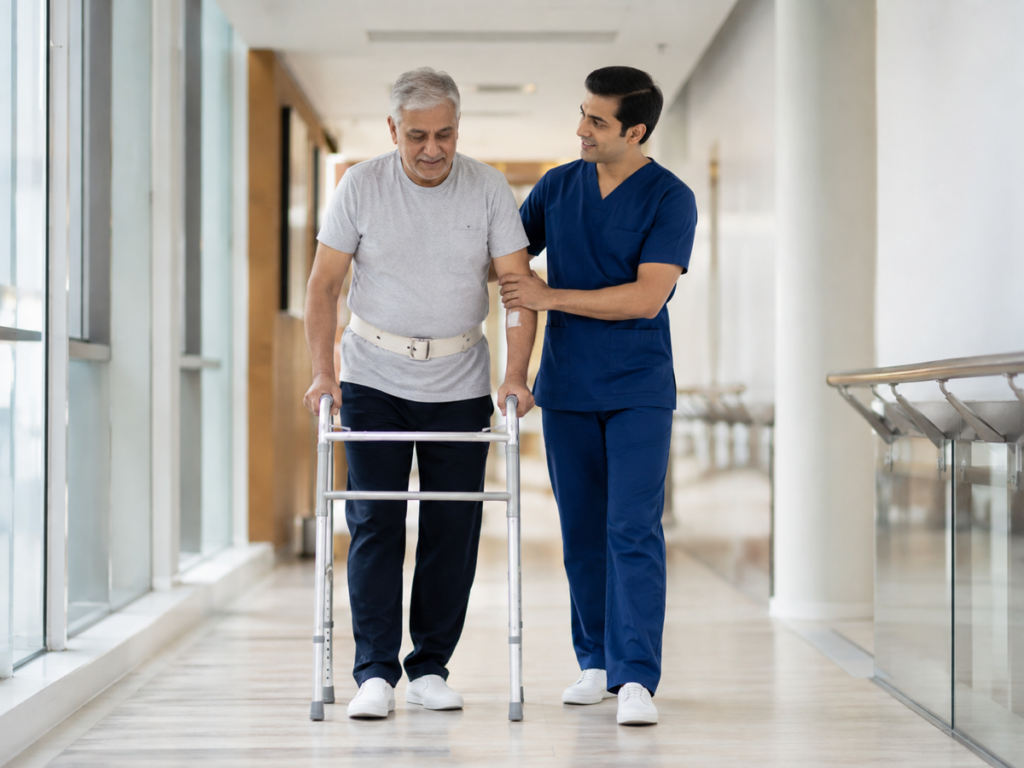
The physiotherapy team visits you in the recovery area 4–6 hours after surgery. You stand up and take your first steps with a walker. This feels alarming. It should not.
Early walking is protective — it prevents blood clots, reduces swelling, maintains muscle tone, and trains the new hip to bear weight correctly from Day 1. Patients who walk on Day 0 consistently have shorter hospital stays and better 6-week outcomes than those who rest in bed.
The target is short, frequent walks — not one long session. Five minutes every two hours beats 20 minutes twice a day. Every hour sitting still is an hour your hip is not learning to work.
2. Get Your Home Right Before Surgery
The most common recovery setbacks happen in the first week at home — and most are preventable with 30 minutes of preparation before the surgery date:
- Raised toilet seat — hip must not bend beyond 90 degrees for 6 weeks. A standard toilet is too low. A raised seat costs Rs. 800–1,500 and removes a daily risk.
- Remove all rugs and loose mats — trip hazards cause falls and dislocations
- Move sleeping to ground floor if possible for the first 2 weeks
- Essentials at waist height — no reaching up or bending down
- Firm chair with armrests at the right height — sofas are off-limits
- Long-handled grabber for items off the floor
3. Take Medication on Schedule — Not Just When in Pain
Pain after hip replacement is manageable when medication is taken proactively. When patients wait until they are in pain before taking the next dose, they end up chasing pain rather than staying ahead of it. Take medications as prescribed for the first two weeks.
Blood thinners are equally important — they prevent DVT (deep vein thrombosis), the most serious early complication after hip replacement. Do not skip these regardless of how well you feel.
Questions about your post-operative protocol? Dr. Gupta’s team is available for follow-up queries.
4. Do Your Physiotherapy Exercises — Twice a Day
Physiotherapy targets not just the hip but surrounding muscles — glutes, quadriceps, hip abductors — weakened by months or years of protecting a painful joint. Ankle pumps, knee slides, leg raises, and hip abduction exercises in the first two weeks. Graduated walking. By Week 4, stairs and balance exercises are added.
The patients who recover fastest are not the fittest going in. They are the ones who do the exercises twice a day, every day, without skipping. It is a repetition problem, not a fitness problem.
5. Sleep in the Right Position
For the first 6 weeks, sleeping position matters. Do not cross your legs or feet. Do not let the operated leg roll inward. Safest position: on your back with a pillow between your thighs. If you sleep on your side, lie on the non-operated side with a firm pillow between your knees.
Poor sleep position is one of the leading causes of early hip dislocation at home — and it is completely preventable.
6. Attend Every Follow-Up
The 2-week appointment — stitches removed, wound reviewed. The 6-week appointment — activity restrictions reassessed. The 3-month X-ray — implant position and bone integration confirmed. Missing any of these delays your return to normal activity.
Call immediately if you notice: increasing redness around the wound, discharge from the incision, fever above 38.5 degrees, sudden increase in pain, or a sensation that the hip “popped.”
7. Nutrition and Protein — Consistently Overlooked
Bone and soft tissue heal using protein. Aim for 1.2–1.5g of protein per kilogram of body weight daily in the first 6 weeks. For a 70kg person, that is 85–105g per day. Eggs, dal, paneer, chicken all count. Most patients in North India are also Vitamin D deficient — a blood test will confirm, and supplementation is usually needed.
Frequently Asked Questions
How soon can I walk without a walker?
Most patients transition from a walker to a single crutch or stick by Week 3–4, and stop using any walking aid by Week 5–6. This depends on pain levels and confidence rather than a fixed date.
When can I climb stairs?
You will be taught to climb stairs before leaving hospital — usually on Day 2 or 3. Good leg goes up first, operated leg second. Coming down, operated leg goes first: “up with the good, down with the bad.”
When can I resume driving?
Right hip with automatic transmission — typically 6 weeks. Left hip with automatic — sometimes 4 weeks. Manual gearbox — 8–10 weeks. Never drive while on opioid pain medication.
Is clicking in the hip normal after replacement?
Minor clicking in the first few months as fluid settles is almost always benign. A loud clunk, a sensation of the hip shifting, or clicking with increasing pain should be reported immediately.