What you will learn
- How the Mako robotic system physically guides implant placement to sub-millimetre precision
- Why accurate cup placement determines implant lifespan over 20 years
- Who benefits most — and what robotic surgery costs at Max Hospital Mohali
Most patients coming in for a hip replacement consultation ask one question before they ask about cost, before they ask about recovery — they ask whether we use the robot. And honestly, that question matters.
Robotic hip replacement is not a marketing term. It changes how accurately the implant is placed, and that accuracy directly affects how long the implant lasts, how quickly you recover, and whether you end up with a leg-length discrepancy or a stiff hip in the years ahead.
At COJRI, Max Hospital Mohali, Dr. Sandeep Gupta performs robotic-assisted total hip replacement using the Mako SmartRobotics platform. Here is what the technology actually does — and what it does not do.
What Robotic Hip Replacement Actually Means
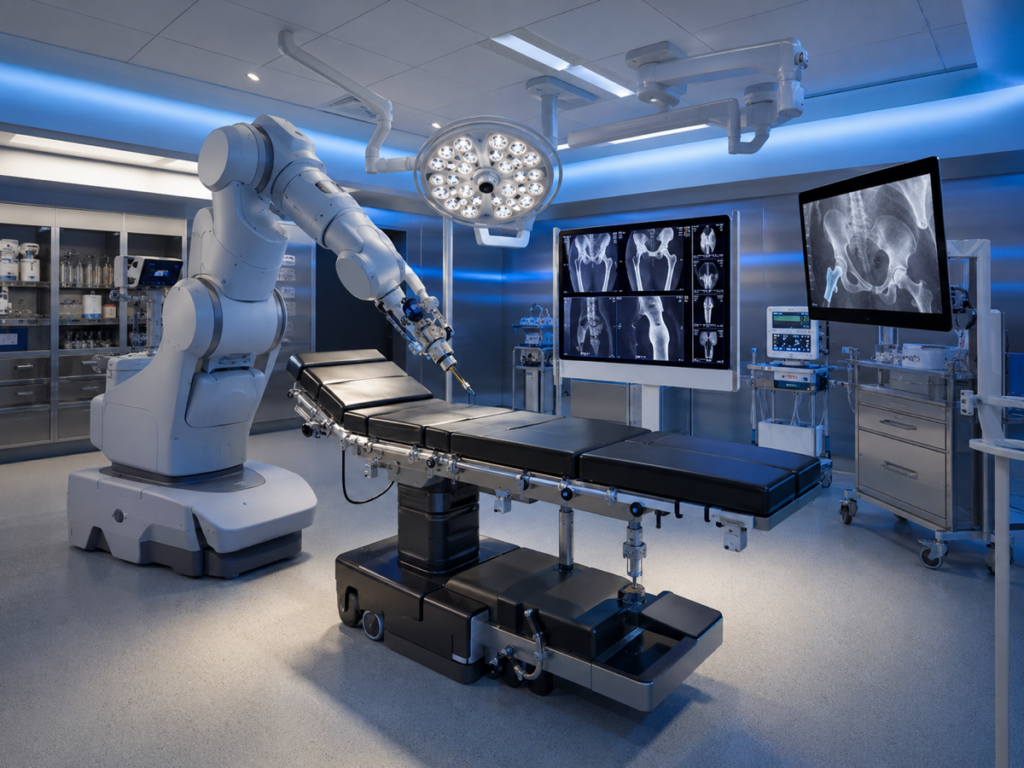
The robot does not perform the surgery. The surgeon still makes every incision, removes bone, and places the implant. What the robotic system does is provide real-time feedback, precision guidance, and a pre-planned 3D map of where every component should go — to within fractions of a millimetre.
Before surgery, a CT scan of your specific hip is used to build a patient-specific 3D model. Dr. Gupta plans the exact implant size, position, and angle on that digital model. During surgery, if the drill drifts even slightly from the planned position, the robotic arm physically resists the movement — preventing the surgeon from going off-plan. Mechanical precision layered on top of surgical expertise.
In traditional hip replacement, implant positioning depends entirely on the surgeon’s experience and intraoperative feel. In robotic surgery, the pre-operative plan is executed with mechanical consistency — regardless of conditions on the day.
Why Implant Position Determines Long-Term Outcomes
The hip socket component — the acetabular cup — must be placed within a very specific range of angles. Too steep, and the hip can dislocate. Too flat, and impingement and accelerated wear follow. This target zone is roughly 10 degrees in any direction.
A cup placed 3 degrees outside the safe zone may feel fine at 5 years and start causing problems at 12. Getting it right on Day 1 is the whole point — and the reason accuracy matters most for younger patients who will live with the implant for decades.
Who Benefits Most From Robotic Surgery
Robotic hip replacement is appropriate for most primary hip replacement patients, but it delivers the biggest advantage in specific situations:
- Patients under 65 who need the implant to last 25–30 years
- Avascular necrosis (AVN) patients whose distorted bone architecture makes 3D planning essential
- Prior hip fracture patients with leg-length discrepancy that needs precise correction
- High-activity patients returning to sport, manual work, or an active retirement
- Revision surgery cases where original anatomy has been altered by a prior procedure
Wondering if robotic surgery is right for your case?
Recovery After Robotic Hip Replacement
Recovery is broadly similar to — and often faster than — standard hip replacement. The incision size is identical. The implants are the same. What changes is the precision of placement, which means less bone is removed unnecessarily and surrounding muscles are disturbed less.
At COJRI, most patients are walking with support 4–6 hours after surgery. Discharge is on Day 2 or Day 3. By Week 6, most patients stop using a walking aid. The advantage of robotic accuracy becomes most visible at the 1-year mark and beyond — fewer episodes of groin pain, better hip stability, and more confidence in the joint during daily life.
Cost of Robotic Hip Replacement at Max Hospital Mohali
Robotic hip replacement at Max Hospital Mohali costs between Rs. 3.5 lakh and Rs. 5.5 lakh depending on the implant chosen — roughly Rs. 50,000–80,000 more than a standard manual hip replacement at the same facility.
Max Hospital Mohali is empanelled with CGHS and ECHS. The robotic procedure is typically covered under the total hip replacement package code. Dr. Gupta’s team will confirm your specific coverage during the pre-authorisation process.
Frequently Asked Questions
Is robotic hip replacement more painful than traditional surgery?
No. Pain levels post-surgery are similar or lower with robotic surgery because the technique is more tissue-preserving. Anaesthesia and post-operative pain management are the same regardless of surgical approach.
How long does the surgery take?
Typically 60–90 minutes for a primary hip replacement. Adding the robotic system does not significantly increase operative time — the planning is completed before you enter the theatre.
What is the difference between robotic and computer-navigated surgery?
Computer navigation tracks instruments and gives real-time feedback but does not physically constrain movement. Robotic surgery (like the Mako system) physically resists drift outside the planned zone — it is a more active and precise system.
Can both hips be replaced robotically in one sitting?
Bilateral simultaneous hip replacement is occasionally performed in carefully selected patients, reducing total hospital time significantly. Dr. Gupta will assess your fitness for this approach after reviewing your case.