What you will learn
- Why AVN is routinely missed on X-ray — and what test actually detects it early
- How quickly AVN can progress from painless to bone collapse
- Which stage determines whether your hip can be saved or must be replaced
Most patients who come to see Dr. Sandeep Gupta for AVN are in their late 30s or 40s. Active people. They were on steroids for a few months — often for an autoimmune condition, a lung problem, or post-transplant. They felt a dull ache in the groin. Their GP ordered an X-ray. The X-ray looked normal. They were told it was a muscle strain.
Six months later, they are on crutches.
This is the story of avascular necrosis (AVN) of the hip — one of the most underdiagnosed conditions in orthopaedics. Not because it is rare, but because it hides. And by the time it shows on an X-ray, the damage is already done.
What Avascular Necrosis Actually Is
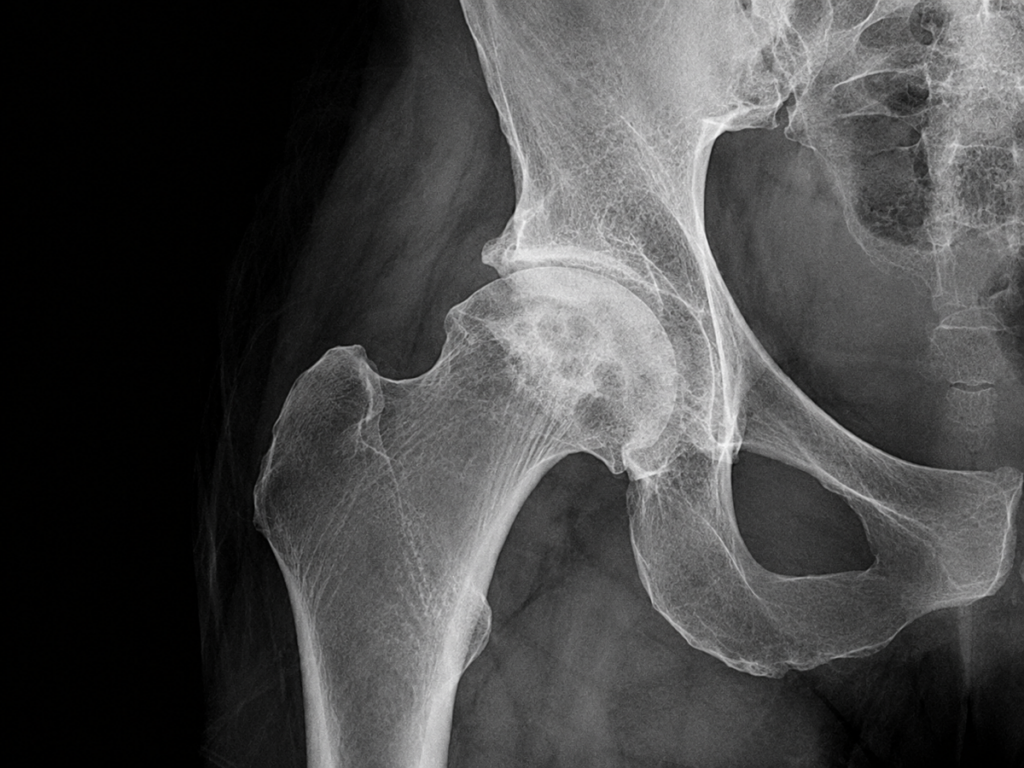
The femoral head — the ball at the top of the thigh bone — has a very limited blood supply, dependent almost entirely on two or three small arteries running along the femoral neck. If those arteries are blocked, compressed, or damaged, the bone tissue starts to die.
Unlike osteoarthritis, which develops over decades of gradual wear, AVN can progress from normal-looking bone to complete structural collapse in 18 months to 3 years. That speed is what makes it dangerous — and what makes early diagnosis so critical.
Why AVN Is Missed: The Silent Phase
In Stage 1 and early Stage 2 AVN, the femoral head looks completely normal on an X-ray. The bone is dying at a cellular level, but its shape is intact. Pain may be mild or absent. This is the silent phase — and it is the window where intervention can save the joint.
If you have risk factors for AVN and groin pain, an MRI of both hips is the right first investigation — not an X-ray. Most GPs order X-rays first, which is understandable but routinely misses early AVN.
Who Gets AVN: Risk Factors
Steroid use is the single largest avoidable cause. Corticosteroids — prednisone, dexamethasone, methylprednisolone — when taken at high doses or for prolonged periods, alter fat metabolism in a way that can block the blood supply to the femoral head. Studies suggest 3–10% of patients on long-term steroids develop some degree of AVN.
- Corticosteroid use — high-dose or prolonged use (most common cause)
- Excessive alcohol — more than 400ml per week for extended periods
- Hip fracture or dislocation — directly interrupts blood supply
- Sickle cell disease or other haemoglobinopathies
- Chemotherapy or pelvic radiation
- Idiopathic — no identifiable cause in 10–20% of cases
On steroids and experiencing groin pain? Do not wait for the X-ray to look abnormal.
Treatment by Stage
Stage 1–2 (bone dying, shape intact): Joint-preserving surgery is possible. Core decompression — drilling channels into the affected area to relieve pressure and stimulate blood vessel growth — can halt progression in 60–70% of early-stage cases.
Stage 3 (crescent sign, early collapse): A crescent-shaped fracture under the cartilage becomes visible. This is the critical decision point. In younger patients, joint preservation may still be attempted. In most cases, hip replacement planning begins here.
Stage 4 and beyond (collapsed joint): Total hip replacement is the definitive treatment. In experienced hands, hip replacement for AVN gives outcomes comparable to replacement for osteoarthritis.
AVN in Young Patients — A Different Conversation
The majority of AVN patients are 30–55 years old. A hip replacement at 40 may need revision surgery at 60–65 — and revision surgery is harder and carries more risk. This is why the conversation with a young AVN patient is not just about right now. It is about implant selection, surgical technique, and planning for a lifetime.
Uncemented implants with highly crosslinked polyethylene or ceramic bearings are typically chosen for younger patients to maximise longevity. Dr. Sandeep Gupta has managed a large number of AVN patients in the 30–55 age group. The approach is always to preserve where the biology supports it — and not to delay replacement when the joint is past saving.
Frequently Asked Questions
Can AVN heal on its own without surgery?
In very early Stage 1 cases with small lesions, spontaneous healing has been reported — but it is uncommon. For most patients, untreated AVN progresses. The question is not whether to treat it, but when and how.
How quickly does AVN progress from Stage 1 to Stage 4?
This varies significantly. Some patients progress from early AVN to collapse in 12–18 months. Others remain stable at Stage 2 for several years. Larger lesions and those involving the weight-bearing portion of the femoral head progress fastest.
What is core decompression?
Core decompression involves drilling small channels through the femoral neck into the dead bone area. This reduces pressure, stimulates blood vessel ingrowth, and can slow or reverse early AVN. It takes about 30 minutes under general anaesthesia and requires crutches for 4–6 weeks.
I have been on steroids for 3 months. Should I get an MRI?
If you have any groin, thigh, or knee pain — yes. High-dose steroid use (equivalent to more than 20mg prednisone/day) for more than 6 weeks is widely accepted as the threshold for elevated AVN risk.