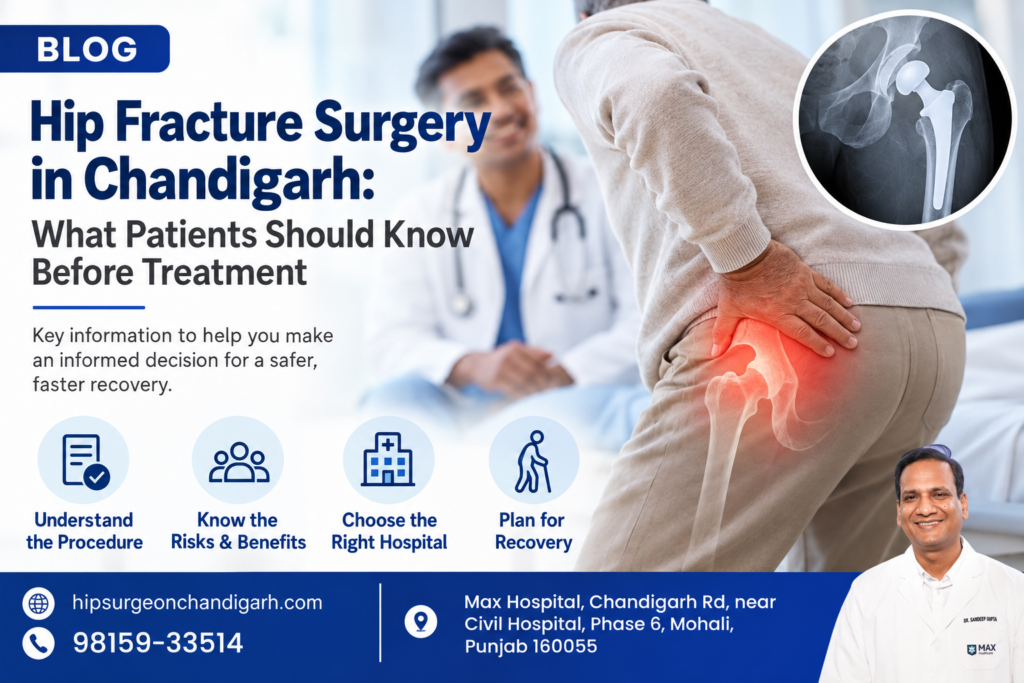
What Hip Fracture Surgery Patients in Chandigarh Need To Know Before the TreatmentIt is normal for people to have their share of queries right before undergoing surgery. If you or a family member is scheduled to go under hip fracture surgery in Chandigarh, you are bound to have similar concerns. Rest assured, understanding the treatment process, surgery details and recovery expectations will help you in taking the right decision.
What is a Hip Fracture?
Fracturing or breaking the upper femur in the region of the hip, almost at the joint, is termed a hip fracture. It can either be a femur neck fracture, an intertrochanteric fracture, or a subtrochanteric fracture. Each of these may require a different treatment approach.
Symptoms of a hip fracture typically include:
Pain in the groin or hip region
Limited ability to walk and stand
Formation of bruising or swelling around the hip
Less range of motion of the impacted leg
Impacted leg looking short or turning out to the side in some cases
A hip fracture should be assessed right away. Leaving this to later may cause severe problems including increased difficulty to move regardless of age; in the elderly this may lead to serious complications.
When is Hip Fracture Surgery Needed?
Treatment options for hip fractures are based on a number of factors for the patient. These include the patient’s age, physical health, and the characteristics of the fracture (site, quality of the bone), as well as whether the fracture has impacted the position or stability of the fractured segment.
In some cases, stabilization of a fracture with surgery allows for earlier rehabilitation for the patient. The specific surgery will be determined by the type of fracture.
Some fractures can be stabilized with internal fixation. Internal fixation uses screws, plates, rods, or other implants to stabilize a bone in its place. For certain fractures of a femoral neck, particularly in the elderly, partial or complete hip replacement may also be an option.
An orthopedist will review a patient’s imaging and the patient’s overall health before deciding on the best course of treatment.
What Happens Before Surgery?
Before hip fracture surgery, a medical evaluation and, in some cases, X-rays, CT scans, or other radiological studies, are done.
Potential issues that the medical team will evaluate include: health status, heart and blood pressure issues, other illnesses, medication allergies, bone health, risks of surgery, functional health status before the injury, and diabetes health status.
If the patient has health issues, such as diabetes, heart issues, or other health issues, the medical team may have to do other procedures to stabilize the health status to allow surgery to occur.
Patients and families should ask the surgeon how long they will have to stay in the hospital, what they can expect before, during, and after surgery, what the risks are, how long the surgery will be, what the rehabilitation will be like, what type of hip replacement system will be used, and what recovery will be like.
Types of Surgical Treatment
There is no surgery that will help everyone. The most common types of surgery for hip fracture are:
Internal Fixation
Internal fixation is done to stabilize a fractured bone using surgical implants or devices.
Partial Hip Replacement
A partial hip replacement, or hemiarthroplasty, means replacing only the femoral head. The patient retains their natural hip socket. This surgery is sometimes an option for select femoral neck fractures.
Total Hip Replacement
Total hip replacement is the removal of the femoral head and socket. This surgery is considered for some patients with certain fracture or joint characteristics who were able to be independent and mobile prior to the fracture.
In these cases, the best course of action is an individual evaluation rather than focusing on patient age.
Benefits Of Timely Treatment
There are many reasons to encourage timely intervention in treating fractures. These include management of pain and stabilization of the fracture. If surgical intervention is considered, then some fractures allow rehabilitation to begin earlier, which may provide these benefits:
Improved fracture stability
Better pain management
Earlier mobilization for the fracture
Limiting bed rest to the time of surgical intervention
Reducing the period of inactivity & allowing returning to daily activities
Recovery for such surgery varies from patient to patient, depending on various factors. These include age, bone health, the fracture type, your general health, adherence to rehabilitation program, etc.
What Is Recovery Like After Surgery?
Recovery after surgery for a hip fracture often involves medical management, pain control, rehabilitation, and controlled movement.
A physiotherapist helps with safe controlled movements, and may help you begin to walk using a walking aid. Instructions about weight bearing are determined by the surgery and the stability of the fracture.
Recovery from surgery requires patients to:
Keep up with their physiotherapy
Use supportive equipment as recommended
Take all prescribed medications
Make sure that they eat enough protein
Follow instructions regarding weight-bearing
Keep follow-up appointments
Do something to mitigate the risk of falling
Recovery also means older patients may need more assistance.
Choosing the Right Orthopaedic Surgeon
Experience is the key deciding factor when selecting an orthopaedic surgeon. The surgeon should be qualified to perform a hip fracture surgery Chandigarh. Families need to consider the surgeon’s experience in dealing with fractures, their experience with different surgical techniques, the types of implants used, the infrastructure of the hospitals, and the post-surgery rehabilitation services offered.
Before the surgery, the surgeon should be able to answer the following questions:
What kind of fracture is this?
Is surgery the only option?
Why is the proposed surgery the best option?
When can I expect to begin walking?
What risks do I need to be aware of?
How long before I can be completely rehabilitated?
What precautions do I need to take once I am back home?
Good communication helps provide clarity to caregivers and families regarding what they should expect through the process of treatment.
Conclusion
Hip fractures are very serious and require prompt medical attention. The type of treatment, whether it is internal fixation or if it requires partial or full replacement, is decided on a case to case basis.
For a hip joint specialist chandigarh, it is important to consult an experienced orthopaedic surgeon for both a complete evaluation and to determine the treatment that best suits you. Knowing the surgery and rehabilitation process, understanding the recovery time, and becoming aware of the risks is important for the family and caregiver to understand what to expect during the process and help the patient to improve both mobility and independence.
NAP — Name, Address and Phone
Name: Dr. Sandeep Gupta — Hip & Knee / Orthopaedic & Joint Replacement Surgeon
Primary location: Max Super Speciality Hospital, Phase 6, Sector 65, Mohali, Punjab 160065
Panchkula consultation: House No. 222, Sector 4, Panchkula, Haryana 134112
Phone: +91 98159 33514
Email: contact@cojri.com